Sunset Workflow - Keeping the list clean
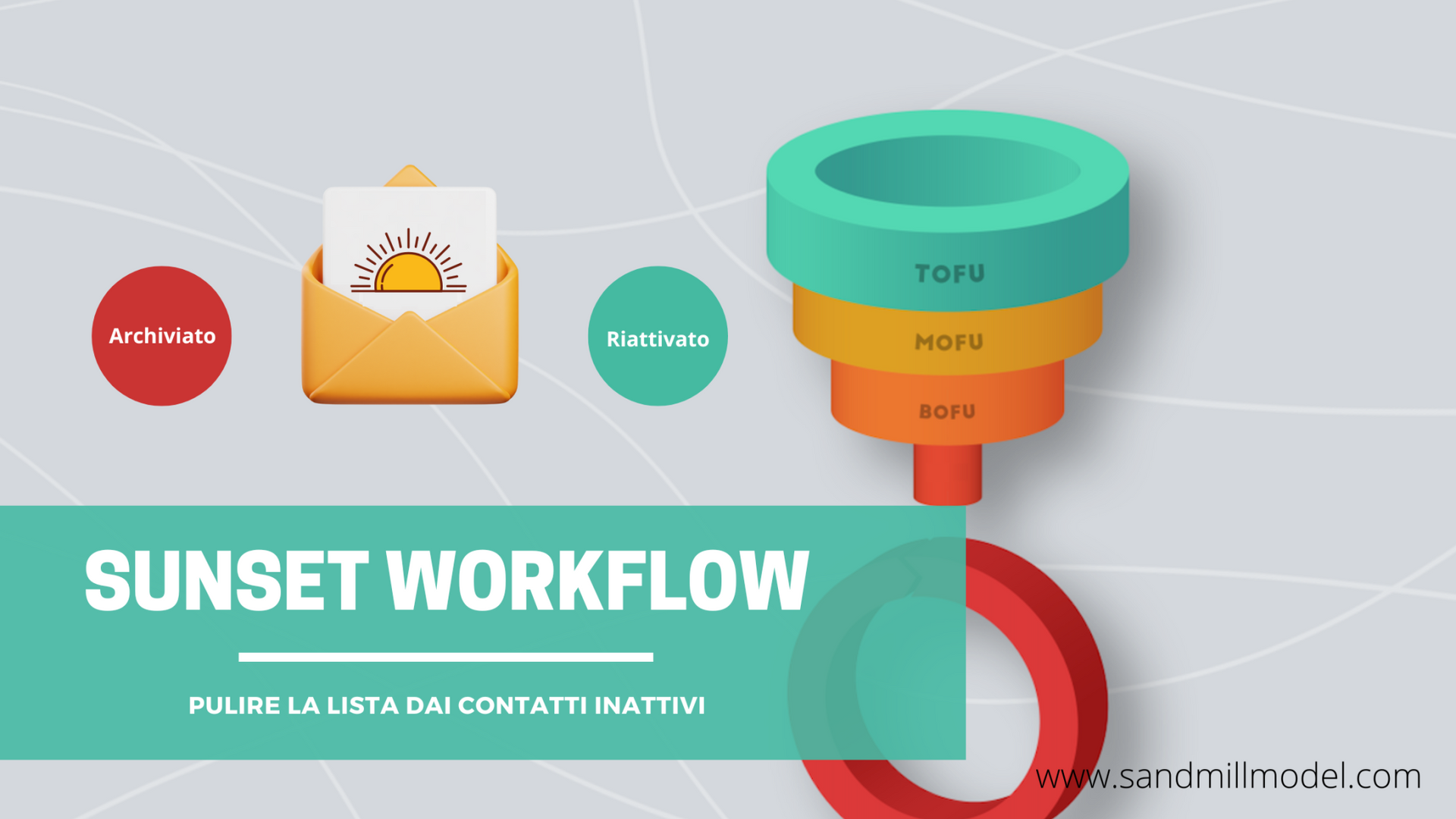
Have you implemented a Sunset Workflow?
It is a fundamental automation to keep your email list clean and efficient.
In this article, I will show you how to implement a process to identify and manage inactive contacts, improving deliverability and the quality of interactions with your audience.
Sunset Workflow: how it works and what it's for
One of the goals of every company that uses email marketing in a healthy way is to communicate with people interested in receiving communications.
It is inevitable that some users have a higher level of engagement than others and therefore interact more with the brand: they read and click on emails, visit the site, purchase frequently, and use the services.
However, there are users who, at some point, just disappear.
They no longer open any emails, they don't return to our site.
They are missing.
Well, at least they haven't unsubscribed, you might say.
Wrong: having many "inactive" users damages our reputation with email providers (such as Google and Yahoo).
This compromises our deliverability, the ability to reach everyone else's inbox, avoiding spam.
Implementing a Sunset Workflow is precisely for this: to clean up our database from those inactive contacts who are not interacting with our emails anymore anyway.
Once set up, the flow gives us one last attempt to reactivate them before their final deletion.
Also remember that keeping the list clean helps us not only maximize deliverability (and therefore effectively reach all "engaged" contacts), but also to improve email marketing metrics (Delivery Rate %, Open Rate %, Click Rate %, Conversion Rate %), making it easier to truly understand the effectiveness of a campaign or an automated flow.
Another significant advantage is of an economic nature: generally, the cost of ESPs depends on the number of contacts in the list. Keeping it clean, removing or archiving inactive contacts also allows us to lower monthly costs.
Once all the advantages are understood, it is clear that every company with a solid lead generation strategy and a healthy and respectful approach to contact management should have an active Sunset Workflow.
Implementing an Effective Sunset Flow
The Sunset Workflow is a Full-Sand-Mill automation.
This means that its target includes all inactive contacts: both the leads in the Funnel and the customers in the Reacquisition Wheel.
To implement a Sunset Flow, you can follow these steps:
1. Identify Inactive Contacts
The first step in building the foundation strategy of the Sunset Workflow is to establish precise criteria for identifying inactive contacts.
This implies defining time windows in which to check a user's activities.
The lack of engagement during this period will lead us to consider a contact as inactive.
Historically, the most commonly used trigger for a Sunset Workflow was the failure to open emails (for example, for 4 months).
The innovations introduced by iOS 14, particularly the privacy feature that prevents tracking email opens, have affected the reliability of this metric.
This means that marketers must now consider other engagement indicators, such as click-through rate or on-site user actions.
Advice:
Instead of relying on email opens, I suggest creating the unengaged user segment in this way:
- Have received over 10 emails in their lifetime
AND
-
No clicks in emails in the last 6 months AND
-
No Site Visit in the Last 5 Months AND
-
No Purchase in the Last 6 Months
2. Activate Re-engagement Strategies
After identifying inactive contacts, the next step in the Sunset Workflow is to implement real "re-engagement strategies" aimed at regaining their attention and interest.
A Sunset Workflow generally includes a minimum of 2 emails and is structured as follows:
- #1 - Initial Re-Activation Email:
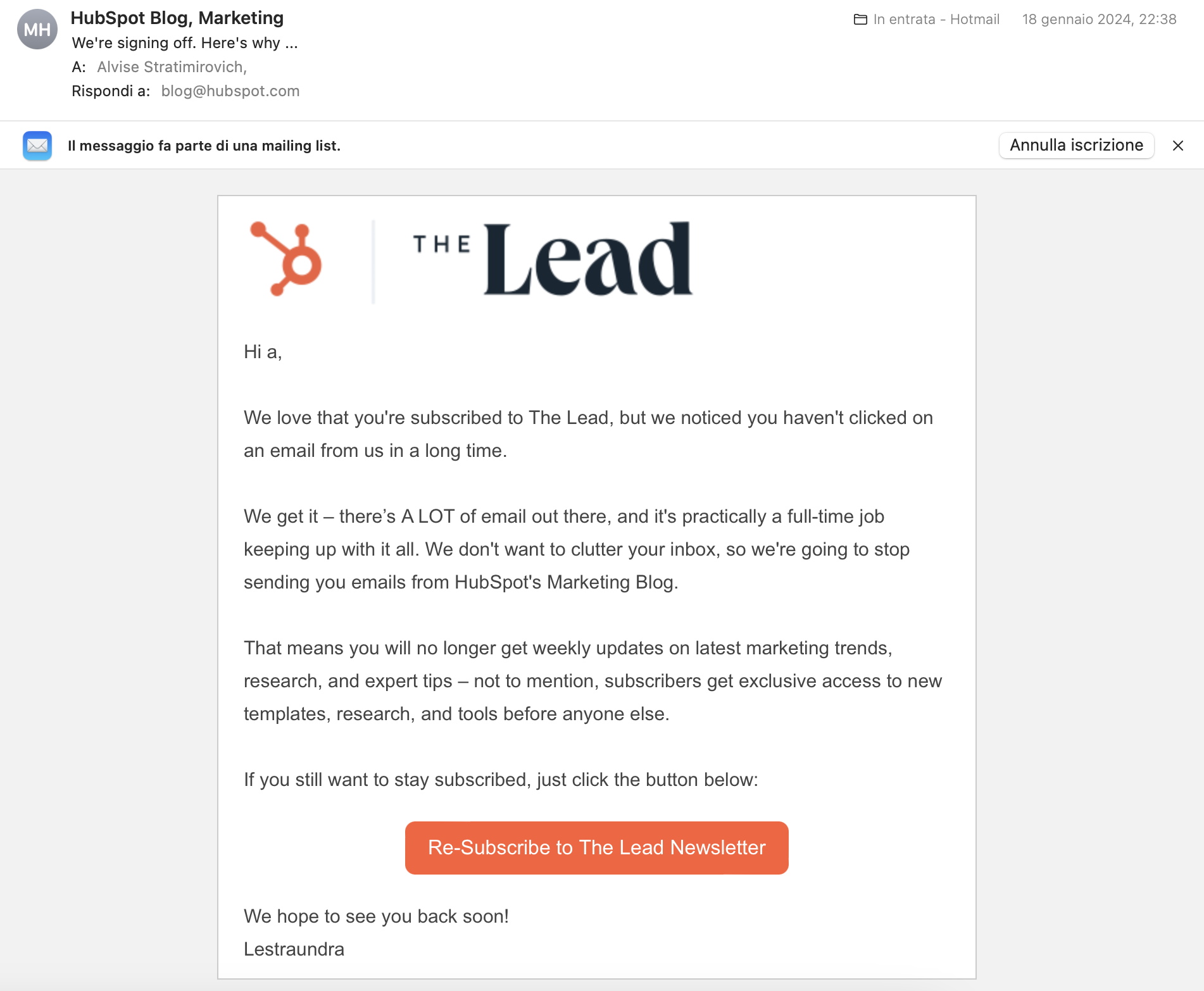
My advice is to have an initial email reminding of the benefits of staying subscribed to the mailing list, especially the added value offered by our Newsletter.
A prerequisite that I take for granted, but which is not so obvious, is to have adequately clarified the Unique Selling Proposition of the newsletter, why people should stay subscribed and open our emails.
This value proposition reminder is followed by the key question: "Do you still want to receive our communications?" with a clear and direct CTA.
It will allow interested parties to "raise their hand".
- Response Management:
If the contact clicks the CTA, they are considered reactivated. Otherwise, we move on to the next step.
- #2 - "Last Chance" Email:
If there is no response, send another communication.
An example could be: "This is your last chance to stay with us. Do you want to continue receiving updates and our resources in advance?"
- Archiving of Inactives:
After this ultimatum, if the user does not interact with the content, we will archive them automatically.
BONUS: Think about integrating WhatsApp
Did you really think you could maximize the reactivation of those who do not interact with emails by sending another email?
You have a better opportunity: use a WhatsApp message.
WhatsApp, with its high open rate and immediacy of communication, offers an alternative channel to reconnect with users.
By using WhatsApp Business API (I explain how it works in this article), we can send a reactivation message with a quick multiple-choice response directly on this channel that is by its nature interactive and conversational.
Hello [name], it's been a while since we last saw each other. Are you still interested in receiving emails with updates and promotions from [brand]?
- Yes, are there any promotions currently?
- No, unsubscribe me
- Only via email, do not contact me via WhatsApp
For those who answer “Yes”, we can propose a dedicated win-back promo.
This approach increases the chances of winning back those users who seemed unreachable via email.
Maximize Deliverability
In addition to the Sunset Workflow, to ensure proper management of the relationship with contacts and to maintain a clean and effective database, I recommend implementing:
- Make unsubscribing in 1 click easy (there's not much more to add here)
- Implement a dedicated Branded Sending Domain (e.g. send.yourwebsite.com)
- Verify that you have configured your domain's DMARC policy
- Set up a Preference Center: Offer the possibility to modify communication preferences, giving the customer control over the type and frequency of emails.
- Ask for Feedback at Unsubscribe: Consider adding a brief survey to understand the reasons for unsubscribing, providing valuable data for future strategies.

Some response options I recommend testing:
- The email content is no longer relevant to me
- Emails are too frequent
- I never subscribed to your emails
- The content is not what I expected
- I already follow the brand on social networks
- Other (the other option allows you to gather additional insights into other reasons behind the unsubscribe)

These steps ensure that your Sunset Policy is not only effective, but also customer-oriented.
Conclusion
The Sunset Workflow is an essential automation for managing inactive contacts.
Implementing it in your business will allow you to reactivate some of them, but also to clean up your list automatically and consequently see an immediate cost savings in the monthly fee of your marketing automation software.
By removing inactive contacts from your database, you will also see better and more accurate performance for your flows and newsletter campaigns.
This activity will be appreciated by email service providers and greatly reduce your chances of ending up in the SPAM folder.
Do you want to optimize your Marketing Automation strategy with my help?